
Is your favorite “turn-me-into-a-Pixar-character” generator putting hidden watermarks on your images?
Berkley Benton
•
September 10, 2026
AI photography has come a long way. You can now create polished, professional-looking brand photos without booking a photographer or spending thousands on a shoot. (And hey, that’s exactly why I offer AI Brand Photography as a service.)
But what’s actually hiding inside that pretty picture?
As AI-generated content becomes nearly impossible to distinguish from the real thing, companies like Anthropic are quietly adding digital markers so AI-generated content can be identified later. And this isn’t just a tech-company preference. There’s a bigger reason these markers are becoming standard in not only images, but text, too:
“Anthropic, along with several other major AI model providers and around 190 total signatories, signed the EU Code of Practice on Transparency of AI-Generated Content in July 2026. This requires AI system providers to use methods of “marking” AI-generated text. We’re applying watermarking globally at launch because we don’t yet have a durable way to scope it by region. However, we will continue to evaluate different approaches, and will share updates when we have them.”
So, companies are getting serious about tracing AI-generated content. Aside from text, do AI images have watermarks? Can you see them? And will your customers know your beautiful website photo was created with AI?
Let’s get into it.
What Is a Watermark?
When I say watermark, you may think of Gemini’s little corner “sparkle.” But did you know that watermarks can be invisible as well? Well, they can be. And in a variety of ways. For a small business, that does matter.
Why Are Watermarks Becoming Standard?
As AI-generated content becomes harder to distinguish from real photography, watermarks and digital identifiers are becoming a way to add transparency. Governments, technology companies, and creative industries are all exploring ways to show where an image came from and whether AI played a role in creating it.
For a small business, that can actually be a good thing. These systems can help build trust without necessarily putting an obvious “AI-generated” label across your website photography.
The goal isn’t to punish businesses for using AI. Thankfully. It’s to make the digital paper trail a little clearer.
And as AI photography becomes more common, wouldn’t you rather know where an image came from?
The EU AI Act
If AI-generated content feels a little like the Wild West, the European Union is starting to put up some road signs.
The EU AI Act includes transparency requirements for AI-generated content, including images, audio, and video. Under Article 50, providers of generative AI systems must use machine-readable markings that allow AI-generated or manipulated content to be detected. These requirements began applying on August 2, 2026. So, fairly recently. Read more about it on: European Commission
That doesn’t necessarily mean every AI image will have a giant “MADE WITH AI” stamp across it. These markings are designed to be machine-readable, meaning they can identify AI-generated content without necessarily changing what you see with your natural eye when you look at the image.
So, what does that mean for the AI images you’re using on your small business website?
We’ll get to that, but first let’s talk about the different ways your generated media is being watermarked.
Types of AI Photography Watermarks
Not all AI watermarks are created equal. In fact, there are only a few different ways an AI-generated image can be identified, and they range from “Yep, I can see that” to “You’d never know unless you checked.”
1. Invisible Pixel Watermarks
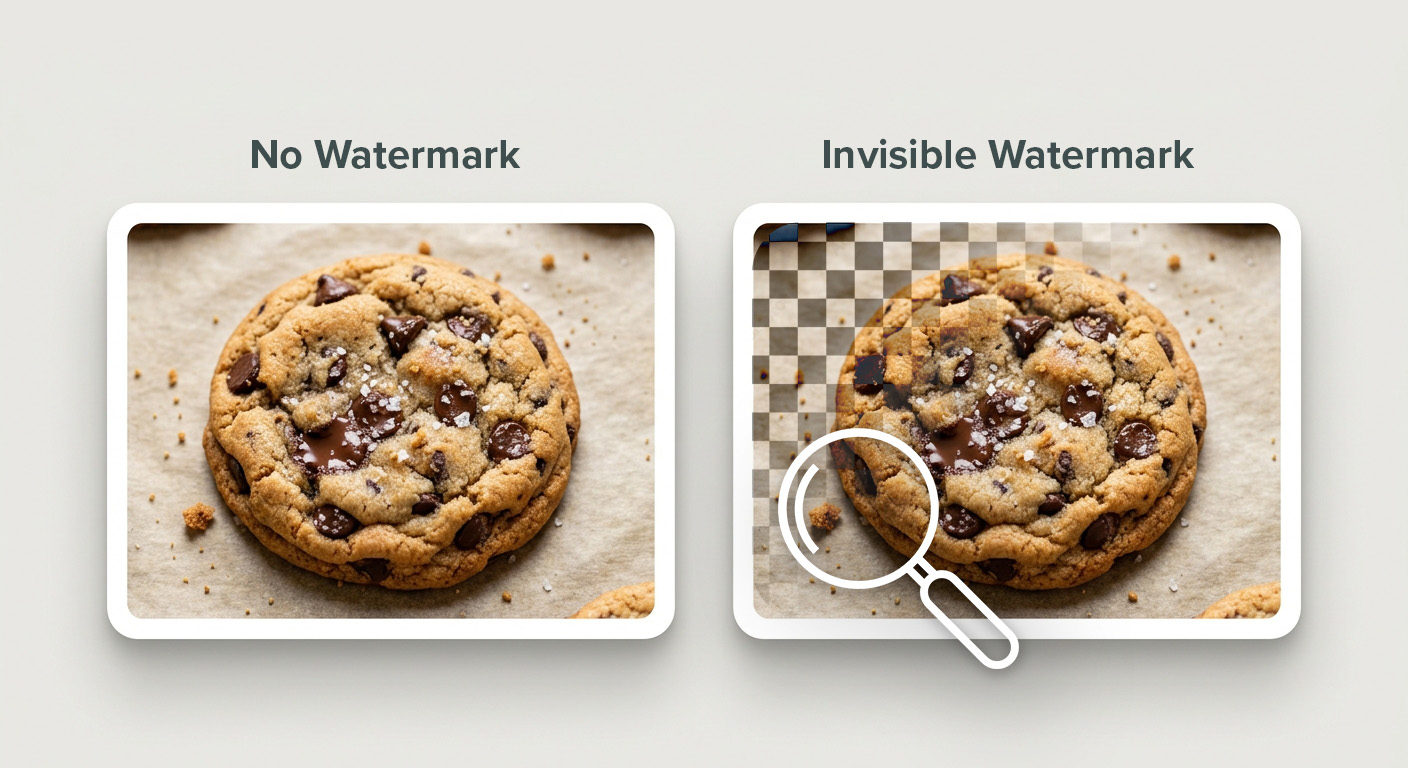
This is probably the closest thing to what you’re imagining when you hear invisible AI watermark.
Some AI generators embed a mathematical pattern directly into the pixels of an image. Google’s SynthID is one example. You can’t see the watermark with your eyes, but a system designed to detect it can look for the pattern.
The catch? Invisible doesn’t mean indestructible. Editing, filtering, adding text, or running an image through another AI model can weaken or remove the watermark.
2. Visible Labels
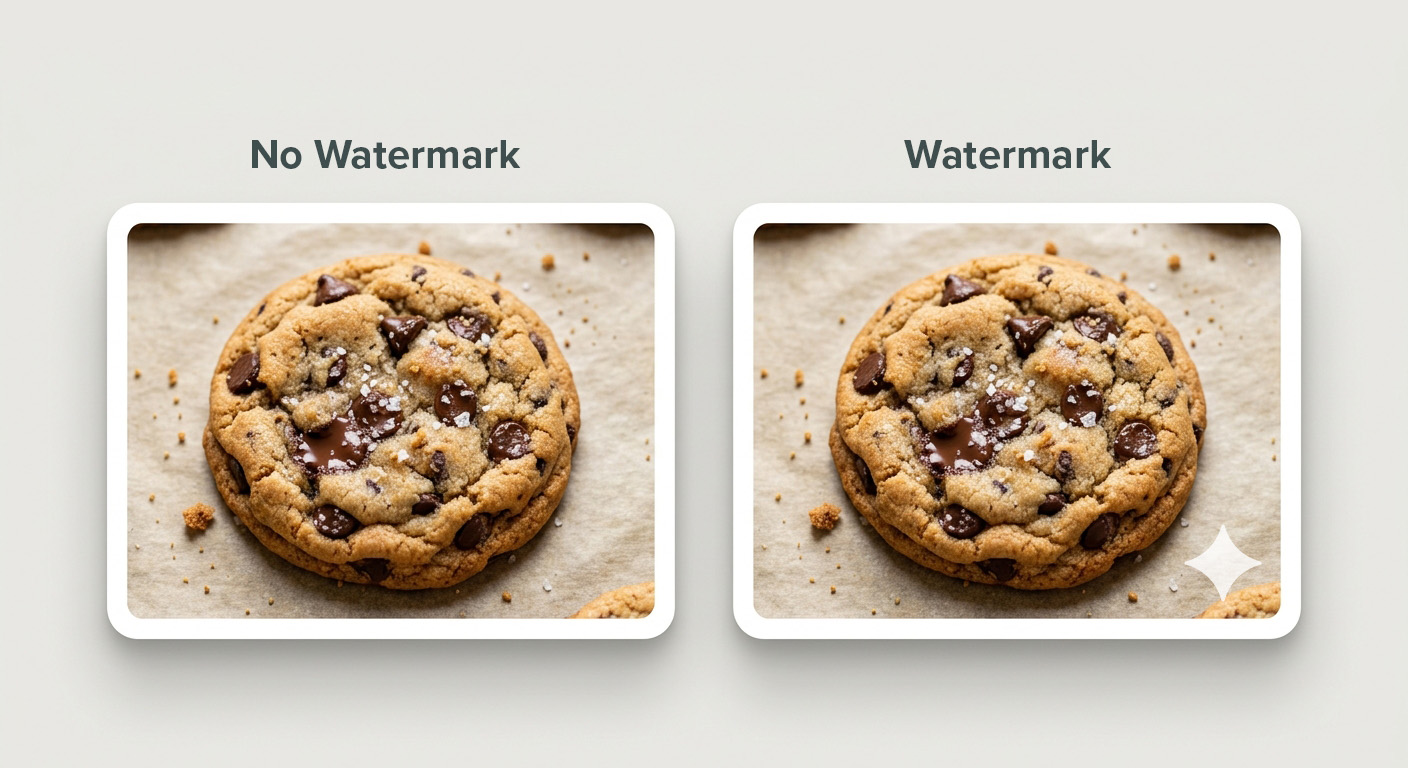
This is the straightforward one. Think of Gemini’s little “sparkle” in the corner.
A visible label tells you right away that an image was generated with AI. It’s easy to understand, but also relatively easy to crop, edit, or remove. Re: The Hive
For a small business using AI photography on a website, this is probably the version you’re most concerned about. Nobody wants a little AI badge competing with their logo.
Fortunately, not every form of AI identification looks like this.
3. Metadata and Content Credentials
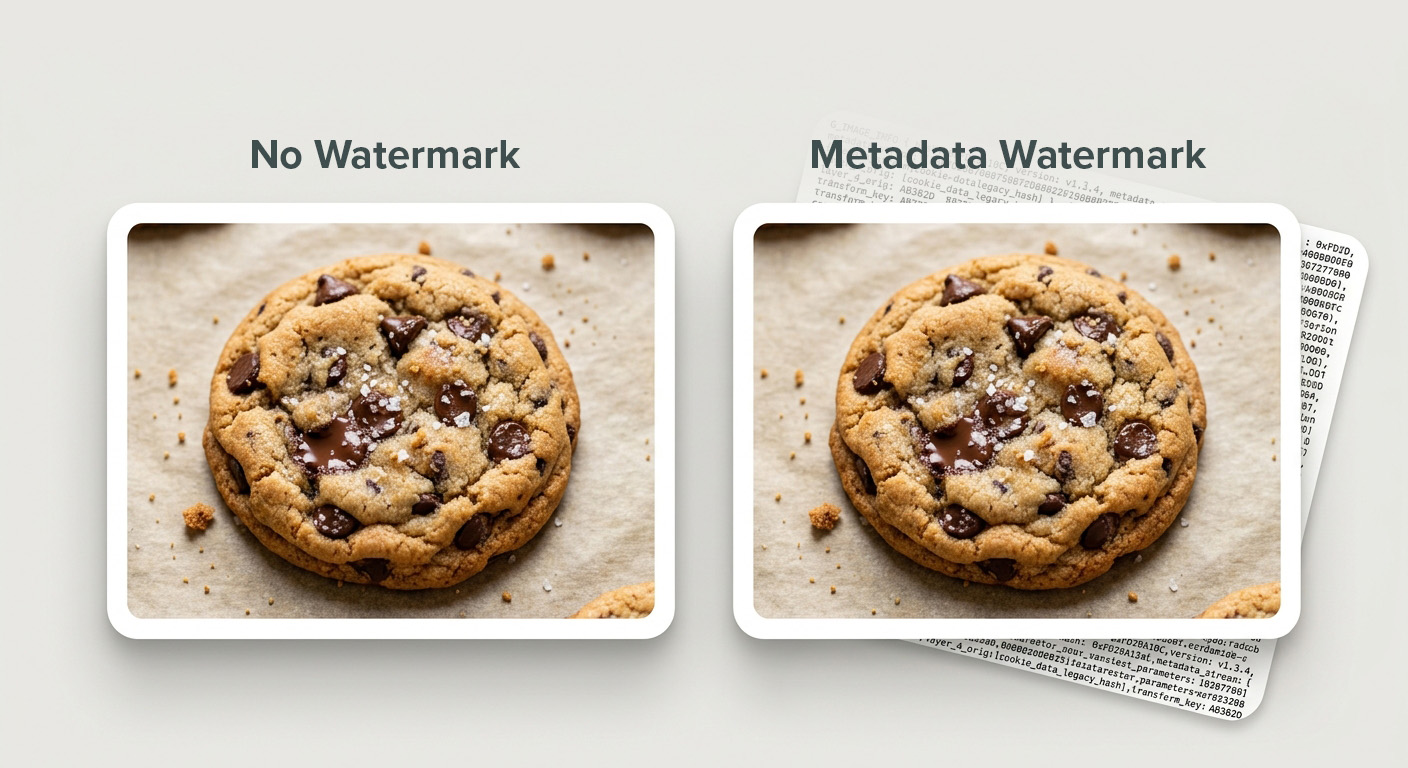
Then there’s the more behind-the-scenes approach: metadata.
An open industry standard called C2PA allows information about an image’s origin and editing history to be recorded in its metadata. It’s being used across photography and creative software, including by camera manufacturers and photo-editing tools. Any C2PA-aware tool can read those credentials.
Unlike a pixel watermark, C2PA metadata doesn’t change the image itself. Think of it less like writing on a photograph and more like attaching a little digital receipt to the backend of it.
Of course, metadata can also disappear when files are edited, converted, or uploaded through platforms that strip it, according to Anthropic.
So when we talk about an AI watermark, we’re really talking about several different technologies with different jobs. The good news? An AI-generated photograph can carry information about its origins without looking any different to the person viewing it.
So if you were worried someone was going to be able to tell that you edited a family member into your last Christmas card photo…. chill.
Legally, Can AI Photography Be Trademarked?
Let’s talk Trademarks and Copyright when it comes to AI-generated content.
Here’s where things get a little tricky: Trademarks protect brands, not photographs. A trademark can be a word, phrase, symbol, design, or combination that identifies the source of your goods or services, according to the U.S. Patent and Trademark Office.
So, for a small business, an AI-generated photo itself generally isn’t what you’d trademark. But an AI-created logo, brand design, or other visual element that identifies your business may potentially qualify for trademark protection if it meets the applicable requirements.
But you might be thinking: “Okay, but can I copyright it?” That’s a different question. Copyright protects original creative works, including photographs, but the U.S. Copyright Office says that material generated entirely by AI isn’t eligible for copyright protection on its own. Human creativity and meaningful human authorship still matter, such as when a person makes creative choices in selecting, arranging, or modifying AI-generated material. If you really really want to know more about what the government will/will not allow you to Copyright when it comes to AI, you can read their trilogy of legal jargon on Copyright.gov’s own website here.
In other words, using AI doesn’t automatically make everything you create unprotectable. But, if you’re counting on copyright or trademark protection for an AI-generated image or design, the details matter. And human creativity must be involved, to some extent.
Does This Change Who Has Ownership or Responsibility for a Given Output?
Not necessarily, but there are two different questions hiding in here: who owns the image, and who’s responsible for using it?
For a small business, ownership will depend on the specific AI tool’s terms of service and any agreement you have with the person creating the image for you. If you’re hiring a designer, it’s worth making sure your contract clearly explains what you’re receiving and what rights you have to use the final images.
Copyright gets a little murkier. In the U.S., the Copyright Office says that purely AI-generated material isn’t protected by copyright, but human-created contributions can be. Creative selection, arrangement, or meaningful modifications may qualify for protection. U.S. Copyright Office
But copyright and responsibility aren’t the same thing. Just because an AI tool generated an image doesn’t mean you get to shrug your shoulders and blame the robot if there’s a problem. Businesses still need to consider how an image is used, including potential issues involving trademarks, likeness rights, privacy, or misleading content. Put shortly? AI is a tool. But if you let it off the leash and it bites someone…. you will be the one in trouble.
AI can change the copyright conversation, but it doesn’t make responsibility disappear.
Should I Be Worried About AI Watermarks?
Probably not. For a small business, an AI watermark doesn’t mean your website photos will suddenly display an embarrassing “AI-generated” label. As we went over in our list, many identifiers are invisible to viewers and simply help verify an image’s origin.
Is There a Way to Avoid Watermarks?
If you’re a small business using AI photography, you probably don’t want a visible “AI-generated” label showing up on every image. The good news is that not all AI identification methods are visible. Some tools use invisible pixel-level watermarks or metadata instead, so an image can look completely normal to the person viewing it.
However, there isn’t a universal trick for removing or avoiding AI watermarks. Different AI generators use different systems, and editing or stripping an identifier may not be reliable. In fact, some invisible watermarks are specifically designed to survive common image modifications. Re: The Hive
So rather than trying to outsmart the watermark, the better question is: does the AI tool you’re using leave a visible mark? If not, your customers may never notice anything different about the finished photograph.
In short,
The bottom line? An AI-generated image can have a digital fingerprint without wearing a giant “MADE WITH AI” sticker. For most small businesses, that’s not something to panic about. It’s simply something worth understanding before you hit “generate.”
Author
Berkley Benton
Berkley is a Web Designer and Developer based in Charlotte, NC. She helps small-to-medium-sized businesses improve their online presence through strategic websites, branding, and marketing. When she’s not designing, you can often find her “work-cationing” with her husband from coffee shops around the world. In fact, she might be sipping an espresso somewhere in Europe while you’re reading this. Or, she may be at home with a cat on her lap. She’s been known to do both.
FAQ's
Do AI-generated images have watermarks?
Yes, some AI-generated images contain watermarks or other digital identifiers. These can include visible labels, invisible pixel-level watermarks, or metadata such as C2PA content credentials. Not every AI generator uses the same system, and many identifiers aren’t visible when you simply look at the image.
Can you tell if an image was created by AI?
Sometimes. AI-generated images may contain visible labels, invisible watermarks, or metadata that identifies their origin. However, these identifiers aren’t always detectable by simply looking at the image. Specialized detection tools or content-credential systems may be able to determine whether AI was involved.
Can AI watermarks be seen?
Not always. Some AI watermarks are intentionally invisible to the person viewing the image. They may be embedded into the image’s pixels or stored in metadata. Other generators use visible labels or icons that clearly identify AI-generated content.
Will customers know if I use AI-generated photos on my website?
Not necessarily. Many AI identification methods don’t change the appearance of an image, meaning customers may never see a watermark or label. However, some AI-generated images can contain metadata or invisible identifiers that reveal how the image was created if someone checks.
Can AI watermarks be removed?
There isn’t one universal way to remove an AI watermark because different generators use different identification systems. Editing an image may weaken some invisible watermarks or strip metadata, while other systems are designed to withstand common modifications. It’s better to understand your AI tool’s policies than rely on removing identifiers.
Are AI-generated images copyrighted?
Not necessarily. The U.S. Copyright Office says material generated entirely by AI isn’t protected by copyright on its own. However, human creative contributions, including the selection, arrangement, or meaningful modification of AI-generated material, may qualify for copyright protection depending on the circumstances.
Should a small business be worried about AI watermarks?
Probably not. For most small businesses, an AI watermark doesn’t automatically mean a visible “AI-generated” label will appear on a website photo. Many identifiers are invisible or stored in metadata. The important thing is understanding how your chosen AI tool identifies and labels generated content.
Does the EU AI Act require AI-generated images to be watermarked?
The EU AI Act includes transparency requirements for AI-generated and manipulated content. Under Article 50, providers of generative AI systems must ensure synthetic image, audio, video, and text outputs are marked in a machine-readable format so they can be detected as AI-generated or manipulated content.
What is a C2PA watermark?
C2PA isn’t technically a traditional watermark. It’s an open standard that can attach information about an image’s origin and editing history to its metadata as content credentials. Unlike a visible watermark, C2PA credentials don’t necessarily change how the image looks to the person viewing it.
Learn more about Improving your online presence

Berkley Benton
• September 10, 2026
Is your favorite “turn-me-into-a-Pixar-character” generator putting hidden watermarks on your images?
Berkley Benton
• August 28, 2026
They all look like they do the same thing, but do they? Sort of.
Berkley Benton
• July 28, 2026
What holistic health clients want to see before they book